
You’ve been told you should be using AI in your business.
So you tried it. You opened ChatGPT, typed “write a Facebook post for my restaurant,” and got back something with the words “culinary journey” and “nestled in the heart of” in it. You thought: this sounds nothing like me. And you quietly went back to doing everything yourself.
That’s the right instinct and the wrong conclusion.
The problem wasn’t the tool. It was the job you gave it. I’ve used AI every working day for years, and the businesses getting real value from it aren’t using better software than you — they’re just asking it for different things.
Here’s what actually works, the one rule that prevents you from embarrassing yourself, and whether it’s worth paying for.
What AI Is Actually Good At
Think of AI as a very fast assistant who has read almost everything, works for ₱1,200 a month (or for most cases, free), never gets tired — and has never met your customers, never seen your shop, and will confidently make things up rather than admit it doesn’t know.
That description tells you exactly which jobs to hand over.
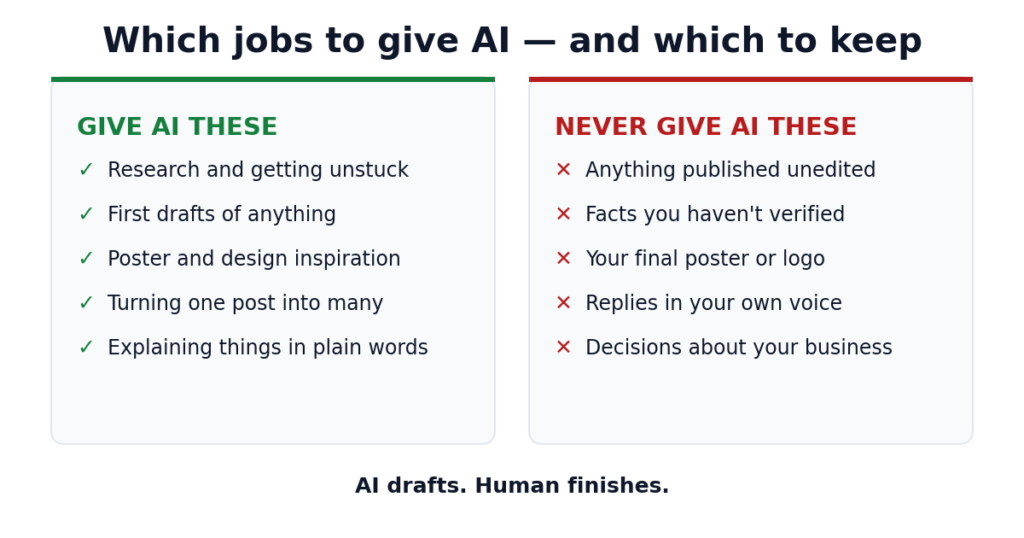
Give it the jobs where speed matters and being wrong is cheap: research, first drafts, brainstorming, summarizing, reorganizing. Keep the jobs where being wrong is expensive: final decisions, anything with your name on it, anything a customer will read as your voice, and anything with a fact you can’t personally verify.
Most people fail with AI because they hand it the second list.
The Five Jobs Worth Handing Over
These are the ones I’d actually recommend to a small business here.
1. Poster and design inspiration. Ask for ten concepts for a promo graphic. Look at what comes back, pick the direction you like — then rebuild it yourself in Canva with your real colors and real details. I’ve written the full workflow in why an AI-generated poster makes your business look cheap, because this is the step most businesses get wrong.
2. Research and getting unstuck. “What are the usual objections when someone shops for a dental clinic?” “Summarize what these three competitor pages promise.” This is genuinely fast, and it’s where AI saves me the most time.
3. First drafts of anything. Emails to suppliers, replies to a difficult customer, a caption you’ve been avoiding for three days. A bad first draft you can fix beats a blank screen you’re avoiding.
4. Turning one thing into many. You wrote a good post. Ask AI to turn it into three captions, an email, and a set of talking points. It’s genuinely good at reformatting things that already exist.
5. Explaining things nobody explained to you. Paste a report you don’t understand and ask for it in plain language. Ask what a quote from an agency actually means. Use it as the patient expert you can ask “dumb” questions without embarrassment.
Notice what’s not on that list: publishing. Not one of these ends with AI’s output going straight to a customer.
What’s Actually Happening in the Philippines
Most articles about AI adoption quote American numbers. Let’s use ours instead, because the Philippine picture is completely different — and much better news for you.
The Philippine Institute for Development Studies, our government’s research institute, studied how ready Filipino businesses are for AI. Here’s what they found.
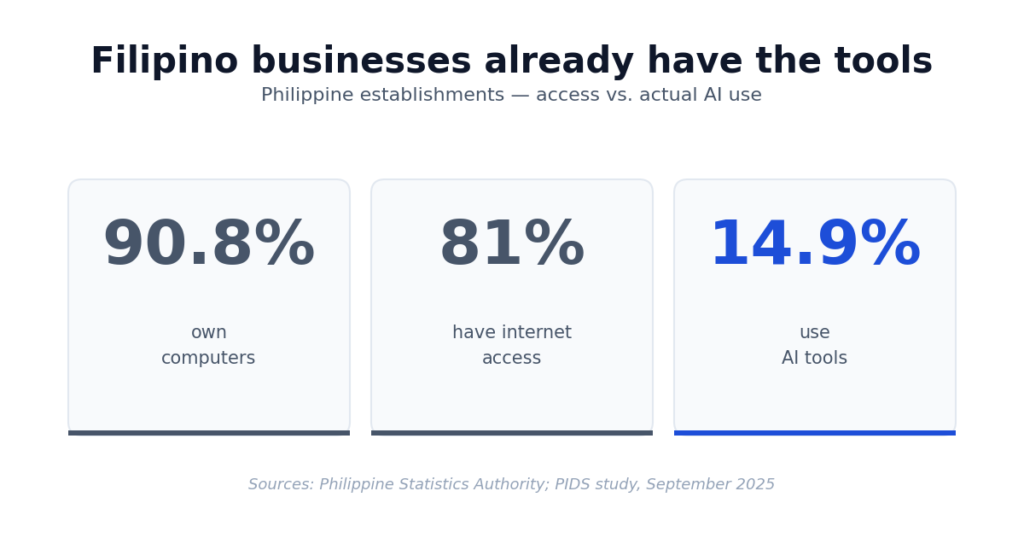
90.8% of Philippine establishments own computers. 81% have internet access. But only 14.9% of firms use AI tools at all.
Sources: Philippine Statistics Authority; PIDS study, September 2025
Sit with that for a second. Almost every business in this country already has the equipment. The laptop is on the desk. The internet is paid for. The thing standing between a Filipino business and AI is not money or infrastructure — it’s that nobody has shown them what to do with it.
The study is blunt about why: awareness. Only about one in five Filipino firms is even aware of AI and related technologies. Not skeptical of them. Not weighing the pros and cons. Simply unaware.
And overall AI adoption across all industries sits at just 3% — with ICT and BPO leading at 6 to 7%, and agriculture at the bottom at 1.5%.
The Part That Matters If You’re Outside Manila
Here’s the line from that study I want you to read twice:
AI adoption in the Philippines is “concentrated in large companies in urban centers,” with Metro Manila and CALABARZON leading, while rural areas are left further behind.
Now, that sentence is written as a problem for the country. For you, sitting in Bacolod or Iloilo or Dumaguete, it’s something else: it’s a description of an empty field.
The big companies in Manila are already moving. A recent survey of Philippine enterprises found nine in ten expect AI-led growth. Meanwhile, in the provinces, most businesses haven’t started — not because they can’t, but because nobody told them it was for them too.
That’s the same gap I keep pointing at in this blog. Your competition down the street isn’t doing this. The tools cost about ₱1,200+ a month and run on the laptop you already own. The window is open right now, and it will not stay open.
What Happens Once Businesses Actually Use It
We don’t have good Philippine numbers yet on time saved, so here I’ll borrow from the US — where the research is further along.
American small businesses report saving an average of 5.6 hours a week using AI tools.
Source: Business.com 2026 Small Business AI Outlook Report (1,009 respondents at businesses under 250 employees)
Five and a half hours is most of a working day, back in your hands. If you’re doing everything manually, you’re not being more authentic — you’re just slower. Authenticity is about what you publish, not how hard you worked to type it.
But the same survey found something that matters even more for this blog. 45% of small business people worry that adopting too much AI could hurt their company’s reputation with customers. Another 39% quietly question whether their business needs as much AI as the trends suggest.
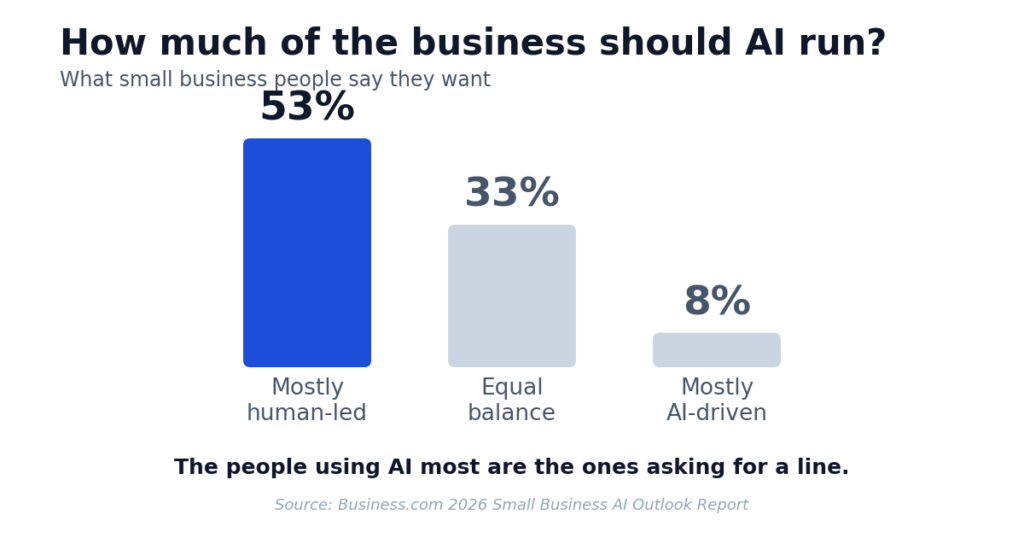
And when asked how much of the business should be AI-run, 53% want operations to stay mostly human-led. Only 8% want AI to dominate.
Source: Business.com 2026 Small Business AI Outlook Report (US data)
Read those together. The people closest to this — the ones already using AI daily — are not asking for more AI. They’re asking for a line. That’s the entire argument of this blog, showing up in someone else’s survey data.
Which Tool Should You Actually Pay For?
My honest advice: pick one and pay for it.
The main three are ChatGPT, Google’s Gemini, and Claude — and these chatbots are what 84% of small business employees actually use, far ahead of every other kind of AI tool. I personally use Claude and Gemini. But I want to be clear about something, because the internet will try to sell you a tool comparison: the difference between these tools matters far less than the difference between using one well and using one badly.
Pick whichever you find easiest to talk to. Stay on it long enough to learn its habits.
Should you pay? The paid plans run about $20 a month — roughly ₱1,200. Here’s the honest test: if you’re opening it a few times a month, stay free. If you’re using it most days for real work, the free tier’s limits will frustrate you within a week, and ₱1,200 is less than one hour of a designer’s time. That’s an easy yes.
What you should not do is subscribe to five tools because five different reels told you to. One tool you actually use beats five you’re paying to ignore.
The One Rule: AI Drafts, Human Finishes
If you remember nothing else, remember this.
AI produces the draft. You produce the thing that gets published. Every time, no exceptions, whether it’s a poster, a caption, an email, or a blog post.
That’s not a moral position — it’s a practical one. AI doesn’t know that your Tuesday promo confused customers last month. It doesn’t know your regular customers call you by your first name. It doesn’t know the event date changed. It will produce something plausible and wrong, and plausible-and-wrong published under your name is worse than nothing.
I follow this rule on this blog. AI helps me research and structure. Then I decide the angle, add what I’ve actually seen working with businesses in Bacolod, cut the generic sentences, and verify every statistic against the original source — which is exactly where AI most often gets things wrong. If I published raw output, you’d know within a paragraph.
Let me be honest about the trade-off: this is slower than copy-paste. It’s supposed to be. The whole return on AI is that it removes the blank page, not that it removes you.
If you want the fuller argument on where the line sits, I’ve written about what AI slop means for your business. And if you’re worried about SEO specifically, Google doesn’t penalize AI content — but the data shows what does get buried.
What to Do Next
Pick one tool this week. Give it one of the five jobs above — I’d start with a first draft of something you’ve been avoiding, because that’s where you’ll feel the benefit immediately.
Then edit what it gives you before anyone sees it. Change the words that don’t sound like you. Add the one detail only you would know. That edit is the entire difference between a business that uses AI well and a business that looks like it stopped caring.
If you found this useful, I write practical digital marketing advice for Philippine business owners — no jargon, no hype.
Sources
- Philippine Institute for Development Studies — Readiness for AI Adoption of Philippine Business and Industry (Quimba, Moreno & Salazar), press release September 2025 — pids.gov.ph
- Philippine Statistics Authority — establishment computer and internet access data, cited in the PIDS study — pids.gov.ph
- BusinessWorld — Majority of Philippine enterprises bullish on AI adoption (Alibaba Cloud survey, July 2026) — bworldonline.com
- Business.com — 2026 Small Business AI Outlook Report (survey of 1,009 workers at US businesses with 2–250 employees, published January 2026) — business.com
- ChatGPT — Pricing plans — chatgpt.com/pricing