Your customer has already made a decision about your business before they’ve spoken to you.
They saw your Facebook page. Your poster. The photo of your storefront. Somewhere in the first few seconds, they decided whether you look like a business that has its act together — or one that doesn’t.
That judgment is what people mean by “branding.” Not your logo. Not your color palette. The impression your materials leave when you’re not in the room to explain yourself.
Here’s what yours are probably saying, what it actually costs to fix, and a ₱5,000 plan for a business that can’t afford an agency.
Branding Isn’t Your Logo
Let’s kill the jargon first.
Branding is not a logo, a font, or a tagline. Branding is the reputation your business has when you’re not around. Your logo is just one of the things that carries it.
Every time someone sees a poster you made, a reply you sent, or a photo of your shop, they’re collecting evidence. Your “brand” is the conclusion they reach after enough evidence piles up.
Which means you already have a brand. You just might not be choosing it.
Think of it like how you dress for a job interview. You’re not lying about who you are by wearing something clean and pressed instead you’re removing a reason for someone to doubt you.
Marketing materials do exactly that job.
The Filipino Shift: Real Beats Polished
Now here’s where most branding advice gets it wrong for our market, and where 2026 changed things.
Filipino consumers have become skeptical of content that looks too perfect. In a February 2026 talk for brand managers, Unbox Creator Network founder Carlo Ople laid out the trends reshaping marketing here: shoppers now tune out flawless endorsements and glossy unboxing videos, and gravitate toward raw, unpolished content from people who feel real.
His line is the best summary of Philippine marketing I’ve heard: “National reach is vanity. Local trust is sanity.”
The numbers back it up. Nano-influencers — accounts with just 1,000 to 10,000 followers — return ₱5.78 for every ₱1 spent, outperforming celebrity partnerships. And 85% of Filipino brands now run integrity checks on creators before working with them, because audiences have gotten good at spotting scripted praise.
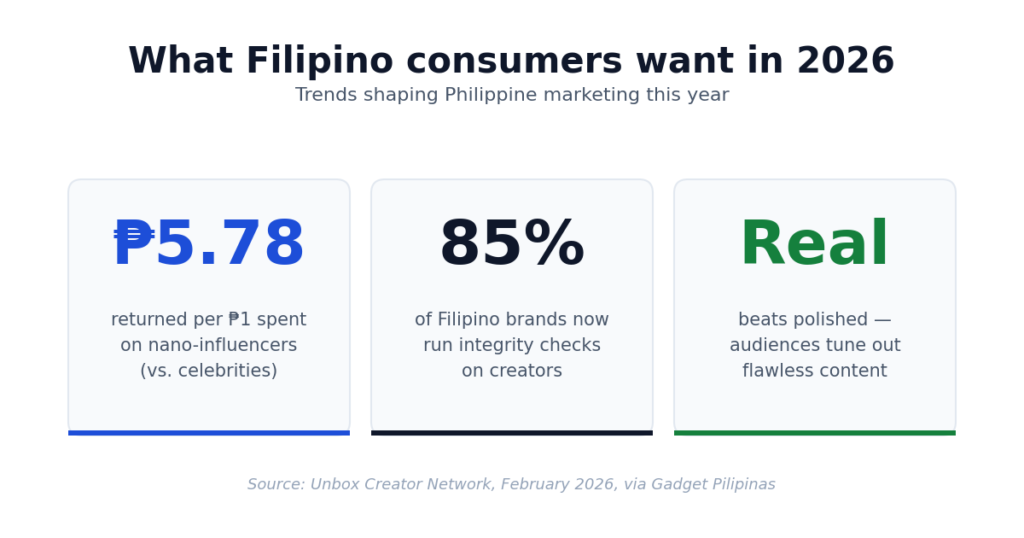
Source: Unbox Creator Network webinar, February 2026, reported by Gadget Pilipinas
So what does this mean for your posters and your page?
It does not mean sloppy is fine. That’s the mistake people make with this trend. Filipinos aren’t rejecting quality — they’re rejecting fakeness. A blurry, badly-typed poster isn’t authentic, it’s just careless. A real photo of your actual staff, shot on a phone, laid out cleanly with correct details — that’s authentic and competent.
The target isn’t polished. It’s honest and cared-for.
That’s also exactly why AI-generated posters land so badly here. They’re the worst of both worlds: fake and effortless. I’ve written the longer version of that argument in why an AI-generated poster makes your business look cheap.
What Your Materials Are Saying Right Now
Open your Facebook page and look at your last ten posts like a stranger would. Here’s the translation guide.
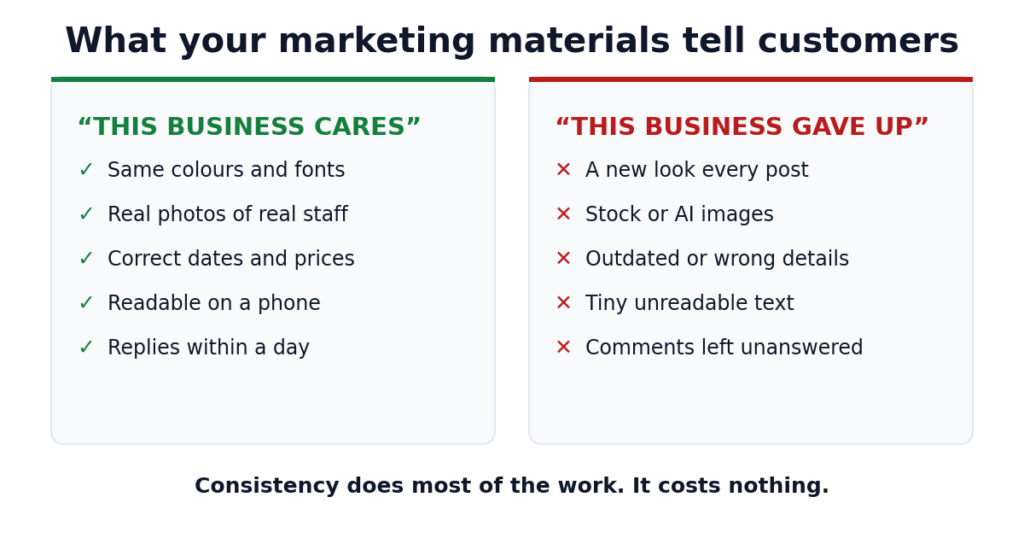
None of the items in that left column require a designer. They require deciding once and then being consistent.
That’s the part people miss. Consistency does most of the work of branding. Using the same two colors and the same font for a year will make you look more established than a business that redesigns itself every Tuesday — even if their individual posters are prettier.
What Branding Actually Costs in the Philippines
This is the question I get asked most, and the internet is unhelpfully vague about it. Real numbers:
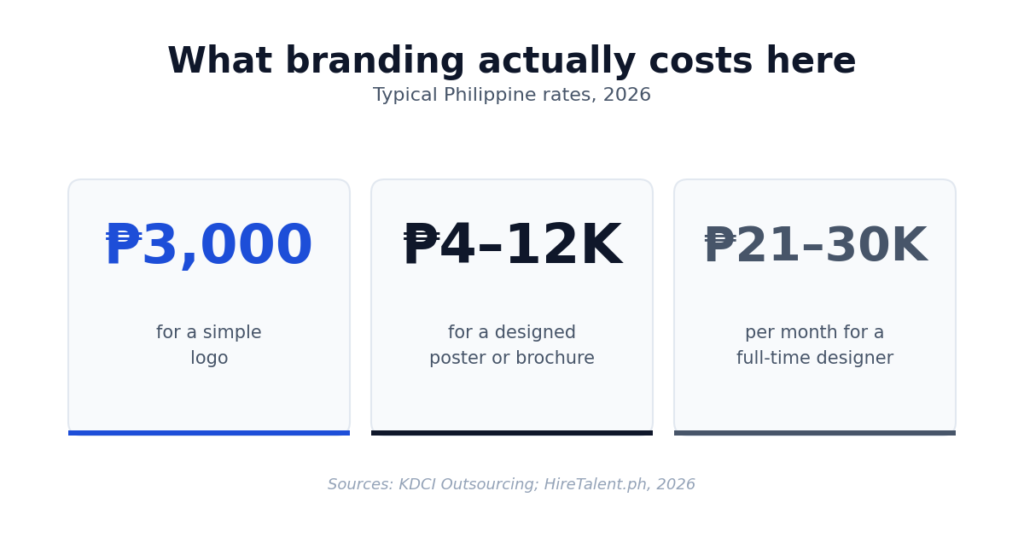
Sources: KDCI Outsourcing; HireTalent.ph, 2026
A simple logo runs around ₱3,000. A properly designed poster or brochure lands between ₱4,000 and ₱12,000. A full-time in-house designer in Manila costs ₱21,000 to ₱30,000 a month.
Let me be honest about what those numbers mean for you. If you’re a small shop posting three times a week, hiring a designer for every graphic makes no financial sense, and I won’t pretend otherwise. But a one-time ₱3,000 for a logo you’ll use for the next five years is not an expense — it’s the cheapest credibility you will ever buy.
The ₱5,000 Branding Plan
Here’s how I’d spend five thousand pesos if you’re starting from nothing.
₱3,000 — a real logo. Hire a freelance designer, not a generator. Ask for the files in PNG with a transparent background plus the original editable file. Ask for a horizontal version and a square version. Those two versions cover almost every place you’ll ever need it.
₱0 — pick your colors and fonts. Two colors and one font. Write them down. Use only those, everywhere, for the next year. This costs nothing and does more than most paid work.
₱0 — Canva. The free version is genuinely enough. Learn it. Canva skill is one of the highest-return things a business owner can pick up this year, because it turns every future poster from a ₱4,000 expense into an afternoon.
₱0 — take real photos. Your phone camera is fine. Shoot near a window, in daylight, and take twenty so you can pick three. Real photos of your actual products and actual people beat stock images every single time, and they’re exactly what Filipino audiences now say they prefer.
₱2,000 — buffer. Save it for one professionally designed poster for your biggest event of the year, or a printed sign that doesn’t look homemade.
That’s a complete visual identity for the price of a decent dinner for four.
About Canva Templates
People ask whether using Canva templates is cheating. It isn’t — as long as you don’t post them as-is.
A template is a starting layout, not a finished design. Change the colors to yours. Change the font to yours. Rewrite the text so the hook is actually good instead of generic. Swap in your real photo. By the time you’re done, the template has done its job — it saved you from a blank page — and the result is yours.
Plug-and-play is where it goes wrong. If someone can tell which template you used, you haven’t finished. Same principle I apply to AI: use it to start, never to finish. The full workflow is here, chatgpt for business.
Two Local Brands Worth Studying
You don’t need to look at international case studies to learn this. Look around Bacolod.
Paddle Co., the local pickleball court, and Posterboy both do something most small businesses don’t: they look like the same business every time you see them. Same visual language, same tone, consistent enough that you recognize a post before you read the name.
Neither is doing anything you couldn’t do. They picked a look and stayed with it. That’s the whole trick, and it’s available to you for free starting today.
What to Do Next
Three things, in order.
First, do the ten-post audit above. Be honest about which column you’re in.
Second, pick your two colors and one font today and write them down somewhere you’ll actually find them.
Third, if your logo came from a free generator or an AI tool and has never been touched by a human, budget the ₱3,000. It’s the single highest-return ₱3,000 in small business.
If you found this useful, I write practical digital marketing advice for Philippine business owners — plain language, no hype.
—
Sources
- Gadget Pilipinas — Filipino Consumers Embrace Authenticity Over Perfection in Marketing (Unbox Creator Network webinar, February 2026) — gadgetpilipinas.net
- KDCI Outsourcing — Cost of Graphic Design Services in the Philippines — kdci.co
- HireTalent.ph — What to Pay Filipino Graphic Designers, 2026 — hiretalent.ph